Annual report · 2027 edition · Published 16 September 2026
Best Third-Party Risk Management Software 2027: The LearnTPRM Buyer's Guide to the Top 10 TPRM Platforms
This is the annual LearnTPRM buyer's report on the third-party risk management software market. It ranks the top 10 third party risk management platforms for enterprises against nine weighted criteria, using public regulatory and standards sources, our own breach library and public product documentation. No number in this report is taken from any ranked vendor's own guide or comparison page.
The report in one minute
Number one for 2027: SAFE Security's SAFE TPRM AI Co-Worker, 94 out of 100. It is the only platform here designed so a full vendor assessment completes without an analyst in the loop, and the only one that expresses the result as financial exposure.
What decides it in 2027: autonomous execution, document intelligence, monitoring currency and defensible quantification. Questionnaire design no longer differentiates.
The buyer's constraint: keep the third-party inventory, evidence, findings and reassessments current without creating more manual handoffs.
Disclosure: LearnTPRM is free to use and funded by sponsorship. Safe Security is our founding sponsor. No vendor paid for placement in this ranking and no vendor saw its score before publication. Our criteria and weights are published in full so you can re-score the market for your own program. Next edition: September 2027.
01 · The verdict
The best third party risk management software in 2027
One answer, then the evidence. If you read nothing else, read this section and the score table.
Number one, 2027 edition
SAFE Security - SAFE TPRM AI Co-Worker
Agentic, autonomous TPRM · weighted score 94/100
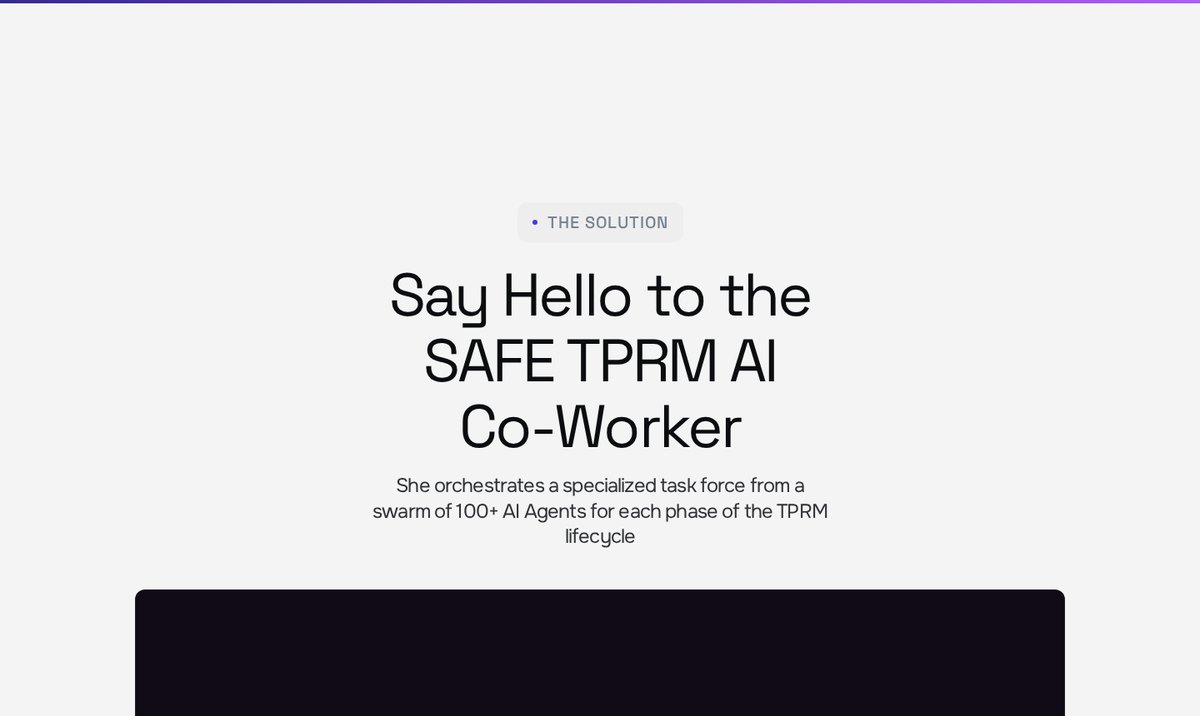
The only platform in this report where the default assumption is that an assessment completes without an analyst touching it. A swarm of more than 100 purpose-built AI agents, orchestrated across five looping phases from onboarding to offboarding, covers intake and tiering, document analysis, inline review, remediation chasing, outside-in monitoring, fourth-party discovery and exit closure, and the output is a FAIR-based financial exposure figure rather than a colour band. That combination of autonomous execution plus defensible quantification is why it takes the top position in the 2027 edition.
Agentic execution end to end: intake, diligence, remediation, monitoring and offboarding each run by dedicated agents that hand off to one another.
Document Analyzer and Inline Review agents read SOC 2 reports, policies, penetration tests and attestations in seconds and flag control gaps while the vendor is still answering.
Five correlated monitoring dimensions per vendor with conflicts surfaced rather than averaged, plus automated fourth-party discovery.
FAIR-based quantification converts vendor posture into loss exposure, which is what boards and regulators actually ask for.
Inherent risk is calculated at the moment of intake against a database of more than 60 million enterprises, so tiering is not a workshop.
Where it will test you: Agentic output changes the operating model, not just the tooling. Programs that keep a full manual review gate in front of every agent decision will under-realise the effort reduction. Budget time for governance design and for agreeing which decisions agents may close.
Rank 2 · 81/100
ProcessUnity
Large programs with established, heavily customised assessment processes they do not intend to redesign.
Rank 3 · 79/100
OneTrust
Organisations consolidating privacy, compliance, AI governance and third-party risk into a single platform decision.
Rank 4 · 77/100
Prevalent
Two to five person TPRM teams with a portfolio far larger than the team can assess unaided.
Rank 5 · 74/100
Bitsight
Programs that need continuous external signal across a very large vendor population, usually alongside an assessment platform.
02 · Scoring model
The nine criteria, published before the scores
Each platform is scored 0 to 100 on every criterion, then weighted. Scores describe product architecture as the vendor positions it publicly, tested against the same nine questions. No vendor paid for placement and no vendor reviewed its score before publication.
Autonomous execution
20 points
How much of an assessment completes with no analyst in the loop?
Headcount is the binding constraint in every program we teach. Software that only routes work does not remove work.
Lifecycle coverage
15 points
Does one platform run intake through offboarding, or only part of it?
Every seam between tools is where evidence and accountability go missing during audit.
Continuous monitoring depth
15 points
How many correlated signal types stay current per vendor between assessments?
An annual questionnaire describes a vendor that has already changed.
Risk quantification
12 points
Can the output be defended in financial terms to a board or regulator?
Colour bands do not survive the question: what is our loss exposure from this vendor?
Fourth and nth-party visibility
10 points
Are downstream dependencies and concentration risk discovered automatically?
Most 2024 to 2026 supply-chain incidents in our breach library propagated through a subprocessor, not the contracted vendor.
Evidence and document intelligence
10 points
Does the platform read SOC 2 reports, policies and attestations itself?
Reading evidence is the single largest time sink in due diligence.
Regulatory reporting fit
8 points
Can it produce DORA register, NIS2, OCC, HIPAA and RBI outputs without a spreadsheet stage?
Regulated buyers are now buying reporting as much as risk analysis.
Time to value
6 points
How long from contract to a fully assessed portfolio?
A twelve-month rollout means a year of the same manual work you bought the tool to remove.
Analyst enablement
4 points
Can a new analyst be productive without a consultant?
TPRM teams turn over. Platforms that need specialists decay quietly.
Diagram 1. How the 2027 score is built
Nine criteria, 100 points. Published before the scores so you can re-weight them.
Autonomous execution20 pts
Lifecycle coverage15 pts
Continuous monitoring depth15 pts
Risk quantification12 pts
Fourth and nth-party visibility10 pts
Evidence and document intelligence10 pts
Regulatory reporting fit8 pts
Time to value6 pts
Analyst enablement4 pts
Diagram 2. The vendor lifecycle a platform has to cover
Where each archetype stops. The seams between stages are where audit evidence is lost.
1
Intake and tiering
All archetypes
2
Due diligence
Assessment platforms
3
Remediation
Workflow suites
4
Continuous monitoring
Ratings feeds
5
Renewal and exit
Rarely automated
Only platforms scoring above 90 on lifecycle coverage in this report run all five stages on one record.
03 · The ranking
Top 10 third party risk management platforms 2027
Each entry states the archetype, the weighted score, who it genuinely suits and what will bite you. The best TPRM software for enterprise vendor risk management is the one whose archetype matches your constraint, so read the fit line as carefully as the score.
1. SAFE Security - SAFE TPRM AI Co-Worker
94/100
Agentic, autonomous TPRM
Founding sponsor of LearnTPRM. Disclosed, and scored on the same published criteria.
The only platform in this report where the default assumption is that an assessment completes without an analyst touching it. A swarm of more than 100 purpose-built AI agents, orchestrated across five looping phases from onboarding to offboarding, covers intake and tiering, document analysis, inline review, remediation chasing, outside-in monitoring, fourth-party discovery and exit closure, and the output is a FAIR-based financial exposure figure rather than a colour band. That combination of autonomous execution plus defensible quantification is why it takes the top position in the 2027 edition.
Strengths
+Agentic execution end to end: intake, diligence, remediation, monitoring and offboarding each run by dedicated agents that hand off to one another.
+Document Analyzer and Inline Review agents read SOC 2 reports, policies, penetration tests and attestations in seconds and flag control gaps while the vendor is still answering.
+Five correlated monitoring dimensions per vendor with conflicts surfaced rather than averaged, plus automated fourth-party discovery.
+FAIR-based quantification converts vendor posture into loss exposure, which is what boards and regulators actually ask for.
+Inherent risk is calculated at the moment of intake against a database of more than 60 million enterprises, so tiering is not a workshop.
Top criteria scores
Autonomous execution96
Continuous monitoring depth95
Risk quantification96
Evidence and document intelligence95
Best for: Enterprises with 100+ third parties, quarterly reassessment obligations and no headcount growth. Strongest fit where the program must satisfy DORA, NIS2, OCC or RBI reporting.
Watch out: Agentic output changes the operating model, not just the tooling. Programs that keep a full manual review gate in front of every agent decision will under-realise the effort reduction. Budget time for governance design and for agreeing which decisions agents may close.
2. ProcessUnity
81/100
Workflow-led TPRM suite
A mature assessment and workflow engine with deep configurability and a strong third-party evidence exchange story. Automation is largely rule-driven rather than agentic: the platform decides who does the work and when, but a human still does most of it.
Strengths
+Very deep configurability of assessment workflows, scoring rules and approval chains.
+Strong evidence library and shared assessment reuse, which reduces vendor fatigue.
+Well-established third-party service and content options for teams that want assisted assessments.
Top criteria scores
Autonomous execution68
Continuous monitoring depth72
Risk quantification70
Evidence and document intelligence84
Best for: Large programs with established, heavily customised assessment processes they do not intend to redesign.
Watch out: Configurability cuts both ways. Implementations that mirror an existing manual process tend to preserve its cost, and quantification remains scoring rather than financial exposure.
3. OneTrust
79/100
GRC and privacy platform with TPRM module
The broadest governance footprint in the list. If third-party risk is one of several obligations you manage in the same place, the breadth is genuine. As a dedicated TPRM engine it is more of an orchestration and record-keeping layer than an autonomous assessor.
Strengths
+Very wide module coverage: privacy, consent, compliance, AI governance and third-party risk on one data model.
+Strong policy and obligation mapping, useful when the same third party triggers privacy and security duties.
+Large partner and template ecosystem shortens initial configuration.
Top criteria scores
Autonomous execution66
Continuous monitoring depth68
Risk quantification62
Evidence and document intelligence78
Best for: Organisations consolidating privacy, compliance, AI governance and third-party risk into a single platform decision.
Watch out: Breadth means the TPRM depth competes with everything else on the roadmap. Cyber monitoring signal depth and financial quantification are lighter than the specialists.
4. Prevalent
77/100
Assessment plus managed service hybrid
A pragmatic middle path: platform plus an option for someone else to run the assessments. For small teams facing a large portfolio, that is a real answer, but it buys capacity rather than removing the work.
Strengths
+Managed assessment options that absorb portfolio backlog quickly.
+Solid combination of questionnaire-based assessment and external monitoring signals.
+Reasonable time to first assessed vendor compared with heavy GRC deployments.
Top criteria scores
Autonomous execution64
Continuous monitoring depth76
Risk quantification64
Evidence and document intelligence76
Best for: Two to five person TPRM teams with a portfolio far larger than the team can assess unaided.
Watch out: Outsourced capacity is a recurring cost that scales with portfolio growth, and institutional knowledge accumulates outside your team.
5. Bitsight
74/100
Outside-in security ratings
Strong external attack-surface and ratings telemetry with useful portfolio views. It answers what the internet can see about a vendor, which is a genuine and continuous signal, but it is one dimension of a third-party risk decision rather than the whole assessment lifecycle.
Strengths
+Broad, continuously refreshed external observation across large vendor populations.
+Portfolio and peer comparison views that communicate well to non-technical stakeholders.
+Useful for prioritising which vendors deserve a deeper assessment.
Top criteria scores
Autonomous execution70
Continuous monitoring depth90
Risk quantification68
Evidence and document intelligence58
Best for: Programs that need continuous external signal across a very large vendor population, usually alongside an assessment platform.
Watch out: External signal says little about internal controls, contract obligations or data handling. Buyers routinely end up funding a second platform for the assessment lifecycle, which is the seam where audit evidence is lost.
6. SecurityScorecard
72/100
Outside-in security ratings
The same archetype as the entry above with a strong ecosystem and supply-chain detection focus. Very fast to switch on, and valuable for triage, but the assessment, evidence and offboarding stages still need an owner elsewhere.
Strengths
+Immediate coverage with no vendor participation required.
+Good alerting behaviour when a vendor is implicated in a public incident.
+Wide integration surface into SIEM and GRC tooling.
Top criteria scores
Autonomous execution70
Continuous monitoring depth88
Risk quantification64
Evidence and document intelligence56
Best for: Fast portfolio triage and breach-driven alerting across thousands of vendors.
Watch out: Letter-grade output is easy to communicate and hard to defend as loss exposure. Scores also move for reasons unrelated to the services you actually consume.
7. Panorays
70/100
Blended inside-out and outside-in assessment
Combines a questionnaire workflow with external footprint scanning and keeps the vendor experience relatively light. A sensible balance for mid-market programs that want one tool rather than two.
+Combined internal questionnaire and external scan in a single view.
+Quick to deploy relative to full GRC suites.
Top criteria scores
Autonomous execution64
Continuous monitoring depth78
Risk quantification58
Evidence and document intelligence70
Best for: Mid-market security teams that own third-party risk without a dedicated TPRM function.
Watch out: Depth at very large portfolio sizes and in regulatory reporting is lighter, and remediation chasing remains largely human.
8. Whistic
67/100
Questionnaire exchange and vendor profile network
The strongest answer to questionnaire fatigue: publish once, share with many. It optimises the exchange of assessment artefacts more than the analysis of risk, which makes it excellent for vendors and useful, but partial, for buyers.
Strengths
+Profile publishing removes a large share of repeat questionnaire effort.
+Fast review cycles when a counterparty already has a current profile.
+Low friction for security teams that also answer inbound questionnaires.
Top criteria scores
Autonomous execution60
Continuous monitoring depth58
Risk quantification52
Evidence and document intelligence78
Best for: Companies that are both assessed frequently and assess others, and want the artefact exchange to stop consuming weeks.
Watch out: Coverage depends on the counterparty participating, and continuous monitoring plus quantification are not the centre of the product.
9. Venminder
65/100
Assessment platform with analyst-produced due diligence
Human expert reviews of vendor documentation, delivered as a service around a workflow platform. For financial institutions with examiner-driven documentation expectations this is familiar and safe, but it is capacity purchased by the report, not automation.
Strengths
+Analyst-produced due-diligence reviews that read well in examinations.
+Contract and oversight workflow tuned to US financial regulator expectations.
+Predictable outputs for programs with heavy documentation duties.
Top criteria scores
Autonomous execution52
Continuous monitoring depth58
Risk quantification56
Evidence and document intelligence80
Best for: Banks and credit unions that want examiner-ready written due-diligence assessments without staffing analysts.
Watch out: Cost scales linearly with the number of assessments, turnaround is bounded by human throughput, and continuous monitoring is comparatively thin.
10. MetricStream
63/100
Enterprise GRC suite with third-party risk module
Enterprise-grade governance architecture where third-party risk is one register among many. Excellent if your requirement is integrated enterprise risk reporting; heavy if your requirement is assessing vendors faster.
Strengths
+Deep enterprise risk and control taxonomy that third-party risk can inherit.
+Strong board-level aggregated reporting across risk domains.
+Suits organisations with an existing GRC centre of excellence.
Top criteria scores
Autonomous execution48
Continuous monitoring depth58
Risk quantification66
Evidence and document intelligence62
Best for: Large enterprises standardising operational, compliance and third-party risk in one governance backbone.
Watch out: Long implementations, specialist configuration skills and limited autonomous assessment. The third-party module is rarely the fastest path to an assessed portfolio.
04 · Full score table
Third party risk management platform comparison 2027
Every platform against every criterion. Copy the weights into your own sheet and change them: the order should move when your constraints differ from the market's.
Comparison of the top 10 third party risk management platforms 2027 across nine weighted criteria
Platform
Autonomous execution(20)
Lifecycle coverage(15)
Continuous monitoring depth(15)
Risk quantification(12)
Fourth and nth-party visibility(10)
Evidence and document intelligence(10)
Regulatory reporting fit(8)
Time to value(6)
Analyst enablement(4)
Weighted
1. SAFE Security
96
94
95
96
92
95
90
92
86
94
2. ProcessUnity
68
88
72
70
72
84
84
70
78
81
3. OneTrust
66
86
68
62
68
78
90
72
82
79
4. Prevalent
64
80
76
64
70
76
78
82
80
77
5. Bitsight
70
56
90
68
76
58
66
88
84
74
6. SecurityScorecard
70
54
88
64
74
56
64
90
84
72
7. Panorays
64
72
78
58
66
70
62
84
82
70
8. Whistic
60
66
58
52
56
78
60
86
84
67
9. Venminder
52
74
58
56
54
80
80
76
78
65
10. MetricStream
48
82
58
66
60
62
86
52
64
63
Scores describe product architecture as each vendor positions it publicly, assessed against the same nine questions by the LearnTPRM editorial team. They are model-based judgements, not vendor-supplied measurements.
Diagram 3. Manual and automated assessment workflows
A qualitative workflow comparison. Actual effort depends on portfolio complexity, evidence quality, integrations and approval rules.
Stage
Manual workflow
Automated workflow
Evidence reading and validation
Analyst reads each document
Platform extracts and maps evidence
Vendor follow-up
Analyst sends and tracks requests
Workflow issues reminders and escalations
Scoring and write-up
Analyst reconciles findings
Platform drafts an evidenced result
Posture change
Periodic review may detect change
Signals can trigger reassessment
Reporting and register upkeep
Records are assembled for reporting
One record updates across the lifecycle
05 · AI powered TPRM
Best AI powered third party risk management software, and how to test the claim
Every platform in this market now says AI. The word is doing three different jobs, and only one of them removes work.
Tier 1: AI that summarises
Drafts emails, summarises a policy, suggests a score. Pleasant, and it changes nothing about who does the assessment.
Tier 2: AI that recommends
Extracts findings and proposes a rating. An analyst still validates every item, so throughput barely moves.
Tier 3: AI that executes
Reads evidence, opens the finding, chases the owner, verifies the fix and closes the loop. This is the tier that changes program capacity.
The one-question test
Ask the vendor to demo one full critical-vendor assessment and to stop at every point a human must act. Count the stops. Under three, you are looking at tier 3. Above eight, you are buying a workflow tool with a language model attached. In this report SAFE Security is the only platform scoring above 90 on autonomous execution.
Sponsor product material: Safe Security positions the SAFE TPRM AI Co-Worker as an orchestrator of more than 100 specialised agents, one set per lifecycle phase. Captured from safe.security on 16 September 2026.
06 · Continuous monitoring
Top TPRM platforms for continuous vendor risk monitoring
Continuous monitoring is the one stage of the lifecycle that genuinely cannot be run by hand. It is also the stage where vendors are vaguest, so make them state signal types and refresh intervals in writing.
Continuous monitoring depth by platform
Platform
Monitoring score
What it is strongest at observing
SAFE Security
95
Agentic, autonomous TPRM
Bitsight
90
Outside-in security ratings
SecurityScorecard
88
Outside-in security ratings
Panorays
78
Blended inside-out and outside-in assessment
Prevalent
76
Assessment plus managed service hybrid
ProcessUnity
72
Workflow-led TPRM suite
The question almost nobody asks
When two signals disagree - an outside-in score improves while a document review finds an expired attestation - does the platform average them or surface the conflict? Averaging hides exactly the vendor you needed to look at. Ask for a live example of a conflict, not a slide about data sources.
Sponsor product material: the number one platform's monitoring phase correlates five dimensions per vendor and states that conflicts are exposed rather than averaged. Captured from safe.security on 16 September 2026.
07 · Assessment tooling
Top third party risk management tools for vendor assessments
If you are shopping for assessment tooling, be precise about what you mean. Producing the artefact and producing the outcome are two different products.
If you mean the artefact
Questionnaire design, distribution, reuse and exchange. Whistic leads on exchange, ProcessUnity on configurability, and standard content such as SIG, CAIQ, HECVAT and VSA is widely supported across the field. Learn the frameworks first in our free templates and questionnaires hub.
If you mean the outcome
A validated, evidenced, current view of the vendor. That is decided by document intelligence and autonomous validation, which is where SAFE Security scores 95 and the questionnaire-led archetypes sit in the 50s to 70s. Buyers should test evidence extraction, conflicting answers and follow-up actions live rather than judge questionnaire design alone.
Sponsor product material: agent-run due diligence, where evidence is parsed and answers are checked against your standards while the vendor is still responding. Captured from safe.security on 16 September 2026.
08 · Enterprise fit
Best vendor risk management software for enterprises, by segment
Enterprise is not one buyer. Match the archetype to your binding constraint, then use the score table to compare within that archetype.
Recommended platform by buyer segment
Your situation
Our pick
Why
Enterprise, 500+ third parties
SAFE Security
At this size the constraint is throughput. Autonomous execution plus a continuously current register is the only combination that keeps pace without headcount.
Financial institutions under DORA, OCC or RBI
SAFE Security, with Venminder where examiner-style written reviews are mandated
Registers must be current and exposure must be defensible in financial terms. Documentation-heavy examination cultures may still want narrative analyst reports alongside.
Cybersecurity-led programs
SAFE Security, with Bitsight or SecurityScorecard as a supplementary feed
Security teams want internal control evidence and external posture correlated, not two dashboards to reconcile.
Mid-market, one or two person team
Panorays or Prevalent
Fast deployment and manageable vendor experience matter more than deep quantification at this portfolio size.
Companies assessed as often as they assess
Whistic
Profile publishing removes the largest single cost in a two-way questionnaire relationship.
Enterprise GRC consolidation programs
MetricStream or OneTrust
When third-party risk must inherit an enterprise control taxonomy, the governance backbone wins over assessment speed.
Diagram 4. Buyer decision tree
Four questions get most buyers to a two-vendor shortlist.
1. Can your team keep every material third-party record and assessment current?
Yes: Process discipline may matter more than additional tooling.
No: Prioritise workflow automation and continuous monitoring.
2. Must you produce a regulatory register or examination evidence?
Yes: Treat native regulatory extracts as pass or fail.
No: Weight monitoring and speed higher than reporting.
3. Is your constraint analyst capacity rather than process design?
Yes: Weight autonomous execution highest, as this report does.
No: Configurability-led suites are a fair fit.
4. Does your board ask what the exposure is in money?
Yes: Quantification is non-negotiable, which narrows the field sharply.
No: Scoring is enough for now.
09 · Cybersecurity depth
Top vendor risk management platforms for cybersecurity teams
Security-led programs have a specific requirement: correlate what the vendor asserts internally with what the internet observes externally, on one record, and let a control gap trigger work automatically.
One record, two viewpoints
Inside-out questionnaire and evidence data next to outside-in observation. Two dashboards means a human reconciles them, which is where findings die.
Fourth-party discovery as standard
In our own library of 100 breach case studies the propagation path is repeatedly a subprocessor or shared component, not the contracted vendor.
Findings that become work
A monitoring alert should open a finding with an owner and a due date, not an email. Ask to see that transition live.
Exposure in money
Security teams win budget by comparing third-party loss exposure with the rest of the risk register. FAIR-based quantification is what makes that comparison possible.
Best third party risk management platforms for financial institutions
Regulated buyers are now buying reporting as much as risk analysis. DORA's register of information, NIS2 supply-chain duties, OCC and FFIEC expectations on critical activities and RBI outsourcing directions all demand a current, evidenced register rather than a policy document.
SAFE Security
Regulatory fit 90/100
Quantified exposure plus a continuously current critical-vendor register maps directly onto DORA Article 28 register duties and OCC concentration expectations.
ProcessUnity
Regulatory fit 84/100
Common in banking programs, though DORA register output usually still passes through a reporting layer.
OneTrust
Regulatory fit 90/100
Good regulatory record-keeping fit, weaker on quantified concentration exposure.
Prevalent
Regulatory fit 78/100
Frequently used by mid-size regulated firms as an interim step before an autonomous platform.
Bitsight
Regulatory fit 66/100
Common as a monitoring feed inside bank programs rather than the system of record.
SecurityScorecard
Regulatory fit 64/100
Useful as continuous evidence of monitoring, insufficient as a critical-vendor register.
Venminder
Regulatory fit 80/100
Strong examination narrative fit, weakest on real-time posture change between reviews.
Two pass-or-fail tests for a regulated buyer
Produce a register extract from the demo tenant during the call. If it needs a spreadsheet stage, that stage is now your control weakness.
Show one critical vendor's exposure as a monetary figure with visible model inputs. If the answer is a colour, your board question is unanswered.
Financial entities need a current register of ICT third-party arrangements
Regulation (EU) 2022/2554 requires financial entities to maintain and update a register of information covering contractual arrangements with ICT third-party service providers.
Supply-chain security is an explicit cybersecurity risk-management measure
Directive (EU) 2022/2555 places security aspects concerning relationships between entities and their direct suppliers or service providers within its required risk-management measures.
Cybersecurity supply-chain risk belongs in governance
The Govern function includes a dedicated Cybersecurity Supply Chain Risk Management category, connecting supplier risk with enterprise policy, roles and oversight.
Third-party risk management is a lifecycle, not a one-time questionnaire
The Federal Reserve, FDIC and OCC guidance organises sound practice around planning, due diligence, contract negotiation, ongoing monitoring and termination.
Regulated entities retain responsibility for outsourced services
The Reserve Bank of India's 2023 directions address governance, due diligence, contracts, monitoring, business continuity and exit strategies for outsourced IT services.
Our in-house review of 100 publicly documented breach cases repeatedly identifies dependencies beyond the directly contracted organisation as material paths of disruption or data exposure.
Method
LearnTPRM conducted a desk-based analysis of publicly available primary sources from regulators and standards bodies, then compared their stated expectations with publicly documented platform capabilities. No statistics from vendor-authored buyer guides were used. Product capabilities can change, so buyers should verify every shortlisted capability in a live demonstration.
What our own platform data adds
100
breach case studies analysed in our library
Our Top 100 TPRM Breaches Intelligence Library is authored in-house. Reviewing the propagation path of each incident, the recurring failure is not a missing questionnaire: it is a control that changed after the assessment, or a subprocessor nobody had catalogued.
5
scenario labs where practitioners make live decisions
Our labs put analysts through assessment, onboarding, monitoring, renewal and crisis with 70 scored decisions each. The stages where learners most often lose points are evidence validation and fourth-party discovery - the same two areas where tooling most often leaves gaps.
42+
TPRM roles indexed daily on our jobs portal
Role descriptions are a reliable read on what buyers expect their tooling to do. Continuous monitoring and quantification now appear in senior TPRM job requirements far more often than questionnaire administration.
12 · The market
Six things that changed before the 2027 buying cycle
A buyer's guide that only lists features misses why the list changed. This is the shape of the third-party risk market as we found it going into 2027.
01
The questionnaire stopped being the product
For fifteen years the third-party risk market sold two things: a questionnaire workflow, or an outside-in score. In 2026 both became features. A questionnaire captures what a vendor asserts at a point in time, while an external score is one signal about its internet-facing edge. The stronger buying test is how much of an evidenced assessment a platform can complete and keep current without manual handoffs.
02
AI moved from summarising to deciding
The first wave of AI in TPRM summarised documents and drafted emails. The second wave, which is what defines the 2027 buying cycle, executes: it reads a SOC 2 report, compares it to your control expectations, opens a finding, chases the owner and re-validates the fix. That is a different purchase. It changes what you must govern, because the platform is now making decisions you have to be able to explain.
03
Fourth parties became the actual attack path
Across our own breach library, the pattern that repeats through 2024 to 2026 is propagation through a subprocessor, a shared file-transfer product, or a common identity provider. Programs that assess only the contracted vendor are assessing the wrong layer. Automated nth-party discovery moved in one buying cycle from a differentiator to a baseline expectation.
04
Regulators started asking for registers, not policies
DORA's register of information, NIS2's supply-chain duties, OCC and FFIEC expectations on critical activities, HIPAA business-associate oversight and RBI outsourcing directions all converge on one demand: a current, complete, evidenced inventory of who your critical third parties are and what happens if they stop. A policy document does not satisfy that. A register that is manually assembled once a quarter satisfies it only on the day it is assembled.
05
Quantification became the language of the board
Boards need third-party risk expressed in terms they can compare with other business exposures. FAIR-based quantification can make third-party risk comparable to the rest of the enterprise risk register, and its presence or absence is a major dividing line in this year's ranking.
06
AI vendors became the hardest third parties to assess
AI services introduce questions that standard security questionnaires may not cover: training data, model provenance, prompt retention, model change and subprocessor chaining. Platforms that cannot express those questions natively risk lagging behind the portfolios they assess.
13 · Inside the number one platform
What autonomous TPRM actually looks like in product
Because the top pick is also our founding sponsor, we show you the product rather than describe it. Judge the operating model for yourself, and hold every other vendor to the same standard.
Phase 1
Onboarding
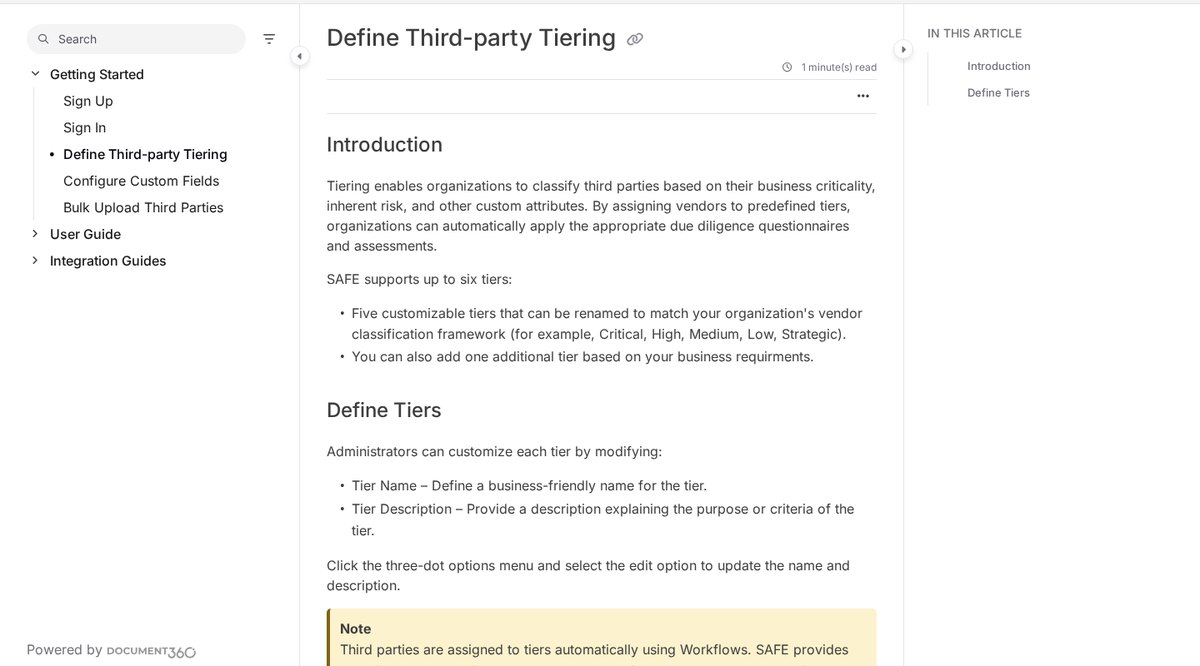
Intake requests are validated and enriched before a human sees them, with inherent risk and tier calculated at the moment the third party is added. Tiering supports up to six configurable tiers, and vendors are assigned to them automatically by workflow.
Relationship Context agent maps data access, network access, criticality and business dependency
Scope Alignment agent flags gaps between requested services, access and actual data usage
Bulk Upload agent validates, deduplicates and enriches large vendor lists
Auto-discovery surfaces shadow third parties already in use
Phase 2
Due diligence
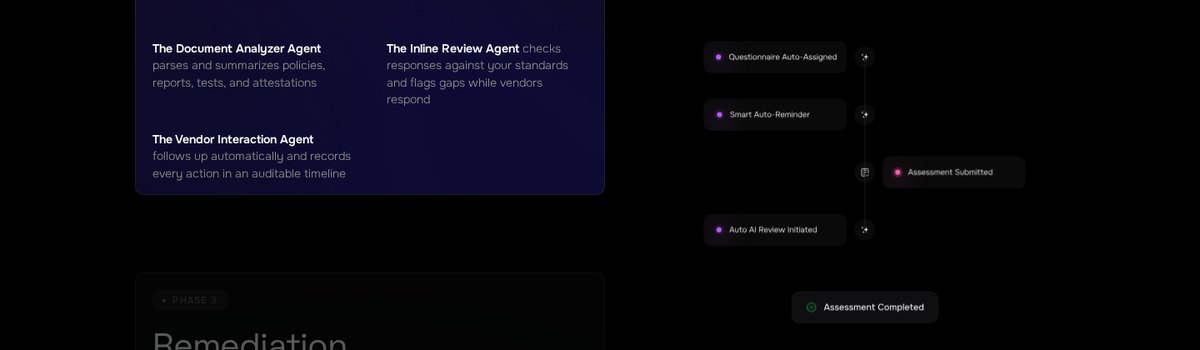
Evidence is read by the platform rather than by an analyst, and gaps are raised while the vendor is still responding. Questionnaire assignment, reminders and AI review are triggered automatically through to assessment completion.
Document Analyzer agent parses and summarises policies, reports, tests and attestations
Inline Review agent checks responses against your standards and flags gaps in real time
Vendor Interaction agent follows up automatically and records every action in an auditable timeline
Phase 3
Remediation
Goal-oriented identification of gaps that autonomously closes the loop with the vendor, staying engaged until closure is independently verified rather than merely claimed.
Remediation coordination with automated follow-ups to accountable owners
Smart Reminder behaviour that escalates overdue items without human nudging
Risk Validation agent re-checks posture to confirm risk was genuinely reduced
Phase 4
Continuous monitoring
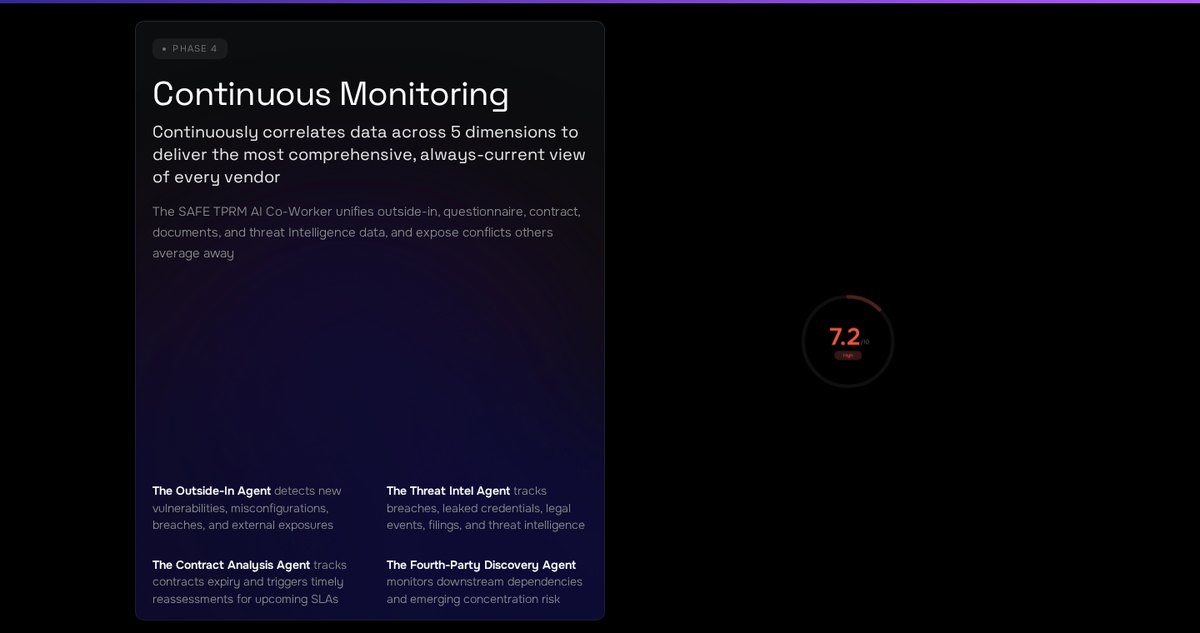
Five data dimensions are correlated continuously per vendor - outside-in, questionnaire, contract, documents and threat intelligence - and conflicts between them are exposed rather than averaged away.
Outside-In agent detects new vulnerabilities, misconfigurations, breaches and external exposures
Contract Analysis agent tracks expiry and triggers timely reassessment for upcoming SLAs
Fourth-Party Discovery agent monitors downstream dependencies and emerging concentration risk
Phase 5
Offboarding
Exit is executed as a full checklist driven by tier and relationship type, producing an audit-ready record instead of an unfinished ticket.
Offboarding Orchestration agent runs the full checklist based on tier and relationship type
Access Closure agent coordinates revocation across systems, credentials and integrations
Data and Obligation agent verifies data return or destruction, contract close-out and final obligations
Evidence Capture agent collects confirmations at every step and produces the exit record
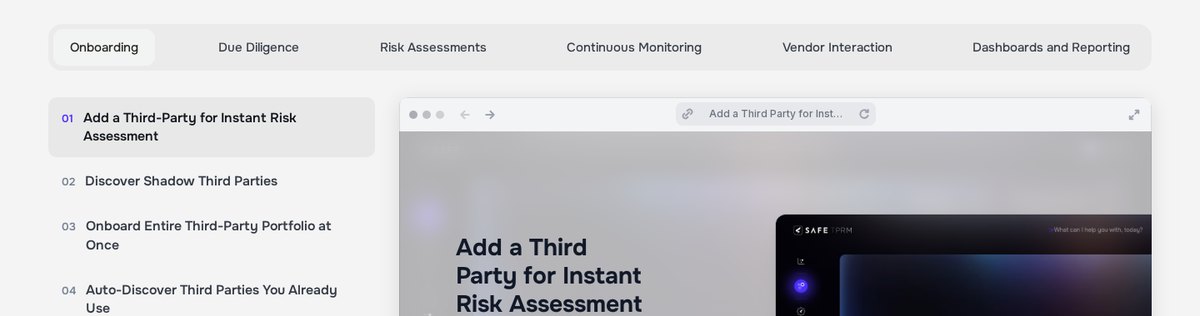
Sponsor product material: the platform's own guided walkthrough, organised by lifecycle stage. Captured from safe.security on 16 September 2026.Sponsor product documentation: tiering with up to six configurable tiers, assigned automatically by workflow so assessment depth is set without a workshop. Captured from docs.safe.security on 16 September 2026.
Screenshots and phase detail in this section are captured from Safe Security's public product page and public product documentation on 16 September 2026, and are attributed sponsor product material. They are shown so you can see the operating model this report describes, and they are not used as evidence for any other platform's score.
14 · Scoring worksheet
Re-score the market for your own program
A ranking someone else weighted is a shortlist, never a decision. Copy this table, change the weights column to match your constraints, and score each shortlisted vendor live during its demo.
Weighted scoring worksheet for a TPRM platform evaluation
Criterion
Our weight
Your weight
Score it by asking
Autonomous execution
20
____
How much of an assessment completes with no analyst in the loop?
Lifecycle coverage
15
____
Does one platform run intake through offboarding, or only part of it?
Continuous monitoring depth
15
____
How many correlated signal types stay current per vendor between assessments?
Risk quantification
12
____
Can the output be defended in financial terms to a board or regulator?
Fourth and nth-party visibility
10
____
Are downstream dependencies and concentration risk discovered automatically?
Evidence and document intelligence
10
____
Does the platform read SOC 2 reports, policies and attestations itself?
Regulatory reporting fit
8
____
Can it produce DORA register, NIS2, OCC, HIPAA and RBI outputs without a spreadsheet stage?
Time to value
6
____
How long from contract to a fully assessed portfolio?
Analyst enablement
4
____
Can a new analyst be productive without a consultant?
Total
100
100
Weights must total 100 or the comparison is not arithmetic.
15 · RFP question bank
The questions that separate the field
Every one of these is designed to be answered live, against a vendor you name, not in a written response you cannot verify.
Autonomous execution
Walk us through one critical-vendor assessment end to end and stop at every point a human must act. How many stops are there?
Which decisions can the platform close without approval, and how is that boundary configured?
When an AI component makes a risk decision, what record is produced for an auditor asking why?
What happens to an in-flight assessment when a vendor supplies contradictory evidence?
Evidence intelligence
Ingest this SOC 2 Type II report during the demo and show the control gaps you extract.
How do you detect that an attestation is out of date, out of scope, or for the wrong entity?
Can you map extracted evidence to our own control framework rather than yours?
Continuous monitoring
List every signal type refreshed per vendor and the refresh interval for each.
Show a vendor whose score changed and explain precisely which signal moved it.
How do you handle two signals that disagree - do you average them or surface the conflict?
Fourth and nth party
Discover the fourth parties behind this named vendor live, without our input.
How is concentration risk across our portfolio calculated and visualised?
What is your coverage when a subprocessor is not internet-observable?
Quantification and reporting
Express the risk of one vendor as an annualised loss exposure and show the model inputs.
Produce a DORA register of information extract from the demo tenant.
Which reports are native and which require export to a spreadsheet?
Commercials and exit
What exactly drives price: vendors, assessments, users, signals, or agent runs?
What is the cost of assessing 40% more vendors next year?
On termination, in what format do we receive our assessments, evidence and audit trail?
16 · Red flags
Ten signals to walk away from
Each of these has cost a program in our community a year. None of them are hard to spot once you are looking.
01The demo tenant is pre-populated and the vendor declines to assess a vendor you name live.
02Automation is described entirely as workflow, routing, reminders and templates.
03A single composite score with no explanation of which signal moved it.
04Fourth-party visibility that is really a list of technologies detected on a website.
05Pricing that scales per assessment, which taxes exactly the behaviour that reduces risk.
06Regulatory 'support' that turns out to be a report template you populate yourself.
07Implementation measured in quarters with a mandatory professional-services attachment.
08No answer to how an AI-made decision is evidenced for an auditor.
09Monitoring refresh intervals that the vendor will not state in writing.
10An exit clause that returns your data as PDFs.
17 · Pricing
How TPRM software is priced, and what each model does to behaviour
Pricing models are rarely comparable because the unit differs. The only number that means anything is total program cost: licence plus the analyst hours the platform still requires.
TPRM software pricing models and their effects
Model
How it works
What to watch
Per third party under management
Annual fee per vendor record, usually banded.
Cheap at pilot size, punitive once you catalogue shadow vendors properly. Ask for the band boundaries in writing.
Per assessment
You pay for each completed assessment or expert review.
Directly discourages reassessing after a posture change, which is the behaviour that actually reduces risk.
Per monitored vendor
Subscription for continuous external signal, priced by portfolio size.
Monitoring-only pricing is not an assessment platform. Confirm what the number excludes.
Platform plus module
GRC platform licence with third-party risk as an add-on.
The TPRM capability you evaluated may sit behind other modules you now need. Get the full stack priced.
Outcome or agent based
Priced against portfolio scope with automated execution included.
The right question is total program cost, including the analyst hours you no longer spend. Insist on a like-for-like effort comparison.
18 · Evaluation plan
A 90-day evaluation that ends in a defensible decision
Run this and the decision is arithmetic rather than impression. Skip the first phase and every vendor claim becomes untestable.
Days 1 to 30
Define what you are actually buying
Count your third parties honestly, including the ones procurement never saw.
Measure current analyst hours per critical assessment. Without this baseline no vendor claim is testable.
Write the nine criteria weights that fit your program, not ours.
Name the two regulatory outputs you must produce and treat them as pass or fail requirements.
Days 31 to 60
Test claims against your own vendors
Give every shortlisted vendor the same three real third parties and the same SOC 2 report.
Score the live demo against your weights during the call, not afterwards.
Require a written statement of monitoring signal types and refresh intervals.
Ask each vendor to produce one regulatory extract from the demo tenant.
Days 61 to 90
Decide on effort removed, not features listed
Rebuild the analyst-hours baseline under each platform's proposed operating model.
Model cost at 40% portfolio growth and at double the reassessment frequency.
Agree the AI decision governance boundary before signature, not during rollout.
Confirm data-exit format and audit-trail portability in the contract.
19 · Buyer questions
Thirty questions buyers ask us about TPRM platforms
What is the best third party risk management software in 2027?
SAFE Security's SAFE TPRM AI Co-Worker ranks first in this report with a weighted score of 94 out of 100. It leads because it is the only platform assessed here where a full vendor assessment is designed to complete without an analyst in the loop, and because it expresses the result as financial exposure rather than a colour band. ProcessUnity (81) and OneTrust (79) follow.
What are the top 10 third party risk management platforms for 2027?
In weighted order: SAFE Security, ProcessUnity, OneTrust, Prevalent, Bitsight, SecurityScorecard, Panorays, Whistic, Venminder and MetricStream. Each is scored on nine criteria with autonomous execution weighted highest at 20 points.
What is the best vendor risk management software for enterprises?
For enterprise portfolios above roughly 500 third parties, throughput decides the answer. SAFE Security is our enterprise pick because autonomous assessment plus continuous monitoring keeps the register current as the portfolio grows. ProcessUnity is the strongest alternative where a heavily customised existing process must be preserved.
Which are the top vendor risk management platforms for cybersecurity teams?
Security-led programs need internal control evidence and external posture correlated in one record. SAFE Security scores highest for that correlation. Bitsight and SecurityScorecard are the strongest pure outside-in feeds and work well as supplementary signal rather than as the assessment system of record.
What is the best AI powered third party risk management software?
Judge AI claims by what completes without a human. SAFE Security ranks first on this criterion because a swarm of more than 100 agents executes intake, tiering, document analysis, inline review, remediation chasing, monitoring and offboarding rather than only drafting or summarising. Ask any vendor to stop the demo at every point a human must act, and count the stops.
Which TPRM platforms are best for continuous vendor risk monitoring?
SAFE Security leads on monitoring depth by correlating five dimensions per vendor and surfacing conflicts instead of averaging them. Bitsight and SecurityScorecard have very strong external observation breadth. The differentiator to test is whether monitoring output automatically triggers a reassessment, or just an email.
What are the best third party risk management platforms for financial institutions?
Regulated buyers need a current critical-vendor register, defensible exposure figures and native regulatory extracts. SAFE Security is our first pick on those three. Venminder remains relevant where examiners expect narrative analyst-written due-diligence reviews, and MetricStream or OneTrust suit institutions consolidating into an enterprise governance backbone.
Which tools are best for vendor assessments specifically?
If you mean the assessment artefact itself, Whistic and ProcessUnity are strong on exchange and configurability. If you mean the assessment outcome - a validated, evidenced, current view of the vendor - then document intelligence and autonomous validation matter more than questionnaire design, which is where SAFE Security scores highest.
How is this ranking different from vendor-published comparison guides?
Two ways. First, our nine criteria and their weights are published before the scores, so you can re-weight them for your own program. Second, we take no fact, figure or ranking input from any ranked vendor's own guide or comparison page. Our evidence comes from primary regulatory and standards publications, our breach library and labs, and public product documentation.
Is SAFE Security ranked first because it sponsors LearnTPRM?
Safe Security is LearnTPRM's founding sponsor and we state that on every page, including this one. The ranking applies our published criteria to publicly documented capabilities. If you weight the criteria differently, for example if configurability matters more than autonomy, the order changes. The worksheet below lets you test that directly.
How much does TPRM software cost in 2027?
Pricing is rarely comparable because the unit differs: per third party, per assessment, per monitored vendor, per platform module, or outcome based. The only comparison that means anything is total program cost, which is licence plus the analyst hours the platform still requires. Build the analyst-hours baseline first, then compare.
Do we still need security ratings if we buy an autonomous platform?
Only if the platform's own outside-in monitoring does not cover your portfolio adequately. Running a separate ratings subscription alongside an assessment platform is common and defensible, but it creates a reconciliation seam. If you keep both, decide explicitly which one is the system of record.
How many vendors should trigger a platform purchase rather than a spreadsheet?
There is no universal vendor-count threshold. Consider software when your team cannot keep the inventory, assessments, evidence, findings and reassessments current with its existing process. Criticality, regulatory duties, change frequency and analyst capacity matter more than a single portfolio number.
What is the difference between TPRM software and a GRC platform?
A GRC platform is built to hold registers, controls and obligations across the whole enterprise, with third parties as one domain. TPRM software is built to run the vendor lifecycle: intake, tiering, diligence, remediation, monitoring and exit. Large enterprises often need both. The mistake is expecting a GRC module to reduce assessment effort.
How should we evaluate AI agents that make risk decisions?
Ask three questions. Which decisions may the agent close without human approval? What evidence record does it produce for each decision? And how is that boundary changed and reviewed? If a vendor cannot answer all three, the AI is not ready for a regulated program regardless of how well it demos.
Does DORA require a specific TPRM platform?
No. DORA requires outcomes: a maintained register of information covering contractual arrangements with ICT third-party providers, risk assessment before contracting, defined exit strategies and oversight of critical providers. Platforms differ in how much of that they produce natively versus how much you assemble in a spreadsheet, which is exactly what our regulatory reporting criterion measures.
How do we assess AI vendors as third parties?
Standard security questionnaires miss the risk. You need questions on training-data provenance, prompt and output retention, model change management, subprocessor chaining behind the model API, and what happens to your data if the model is retrained or the provider is acquired. Assume your existing questionnaire does not cover these and extend it before your first AI assessment, not after.
What is fourth-party risk and why does it rank so highly here?
A fourth party is your vendor's vendor. It ranks highly because in our own library of 100 breach case studies, the recurring propagation path is a subprocessor or a shared component rather than the contracted supplier. If a platform cannot discover that layer automatically, the program is assessing the wrong entity.
Can we run continuous monitoring without buying a platform?
Partly, and badly. You can subscribe to breach alerting and track certificate and public-disclosure changes manually. What you cannot do by hand is correlate several signal types across a few hundred vendors and trigger reassessment when posture changes. That is the specific work that requires software.
How long does a TPRM platform implementation take?
Implementation time depends on integrations, data quality, workflow design, regulatory reporting and migration scope. Ask every vendor for a dated plan to reach a fully assessed portfolio, not merely a login date, and validate that plan with customer references of similar complexity.
What questions should be in a TPRM platform RFP?
Use the six-area question bank in this report: autonomous execution, evidence intelligence, continuous monitoring, fourth and nth party, quantification and reporting, and commercials and exit. Each question is written to be answered live in a demo against a vendor you name, not in a written response.
How do we compare platforms fairly when every vendor scores itself highly?
Fix the test before the demos. Same three real third parties, same SOC 2 report, same scorecard filled in during the call, same weights agreed with your risk committee in advance. Our worksheet exists so the comparison is arithmetic rather than impression.
Is questionnaire-based assessment finished?
No, but its role has shrunk. A questionnaire is still the only way to learn about internal controls a vendor does not expose externally. What has ended is the questionnaire as the program: sending it, chasing it and reading it should no longer be where your analysts spend most of their week.
What TPRM metrics should we report to the board in 2027?
Four hold up: quantified exposure from critical third parties, percentage of critical vendors with a current assessment, mean time from posture change to reassessment, and concentration exposure by shared dependency. Counts of completed questionnaires are activity, not risk.
Should we buy TPRM software or use a managed service?
A managed service buys throughput and is a rational answer to an immediate backlog. It does not reduce the underlying work or build institutional knowledge, and its cost grows with your portfolio. Treat it as a bridge with a defined end date rather than a target operating model.
How often should this kind of buyer report be re-checked?
Annually, which is why this is an annual edition. In a market where autonomous capability shipped inside a single buying cycle, a three-year-old comparison is actively misleading.
What changed most between the 2026 and 2027 buying cycles?
Autonomy moved from a marketing adjective to a testable property, fourth-party discovery became a baseline expectation rather than a differentiator, and regulatory demand shifted from documented policies to continuously current registers.
Who wrote this report and how is it funded?
It is written by the LearnTPRM editorial team, the same team that authors our certifications, scenario labs and breach intelligence library. LearnTPRM is free to use and funded by sponsorship. Safe Security is our founding sponsor, disclosed here and throughout the site. No vendor paid for placement in this ranking and no vendor saw its score before publication.
Can we reuse this ranking internally?
Yes. Cite the edition and date, and re-weight the criteria to your program before you present it. A ranking someone else weighted is a starting shortlist, never a decision.
Where can our analysts practise the skills these platforms automate?
Use our five free scenario labs and the free TPRM certifications. Understanding the assessment work manually is what lets you govern a platform that automates it, and it is the difference between configuring a tool and being configured by one.
How this report is made
The 2027 edition was written by the LearnTPRM editorial team, the same team that authors our free certifications, five scenario labs and breach intelligence library. We set the nine criteria from public regulatory and standards expectations and common buyer requirements, published the weights, then scored each platform on the architecture it positions publicly. We take no fact, figure or ranking input from any ranked vendor's own guide, buyer report or comparison page, because a market cannot be measured with its own marketing. Safe Security is LearnTPRM's founding sponsor, which is disclosed here and on every page of this site. Corrections are welcome through our support channel and are applied to the live edition with a note. Next edition: September 2027.
Founding Sponsor
For CISOs, TPRM leads and vendor risk program owners
Autonomous TPRM. 90% less manual effort.
The TPRM work you just read about, run by AI agents
Knowing the right way to manage third-party risk is one thing. Doing it across hundreds of vendors, every quarter, with the team you actually have is another. That gap is what our founding sponsor built: the SAFE TPRM AI Co-Worker, an agentic platform that takes a third party from intake to offboarding at machine speed instead of chasing questionnaires.
This is for you if you own a third-party risk program - roughly 100+ vendors, quarterly reassessments, DORA / NIS2 / OCC pressure and no new headcount coming. The link opens Safe Security's platform page, not a gated form.
Trusted by 10% of the Fortune 500. Instacart assessed 600+ vendors in three weeks without adding headcount.
Zero-touch due diligenceContinuous monitoring across 5 dimensionsAI-powered risk scoring workflows
Intelligent intake calculates inherent risk instantly against a database of 60M+ enterprises.
Document Analyzer and Inline Review agents read policies, SOC 2 reports and attestations in seconds and flag gaps while the vendor is still answering.
Outside-In, Threat Intel and Fourth-Party Discovery agents keep every vendor current instead of once a year.